| All visitors of this page acknowledge, that they visit a private page, and they confirm that they will not claim anything which should derivate from the contents of this privat page. Entering the page means that you agree with this terms. All visitors acknowledge that they will not act against the administrators or authors of the text on this page by no means. If they will not agree to these terms, they must leave this page immideately."Code 431.322.12 of the Internet Privacy Act" 1995 |
The Pizka-Classic
® hier klicken für die deutsche Version
HeGaDeu.htm
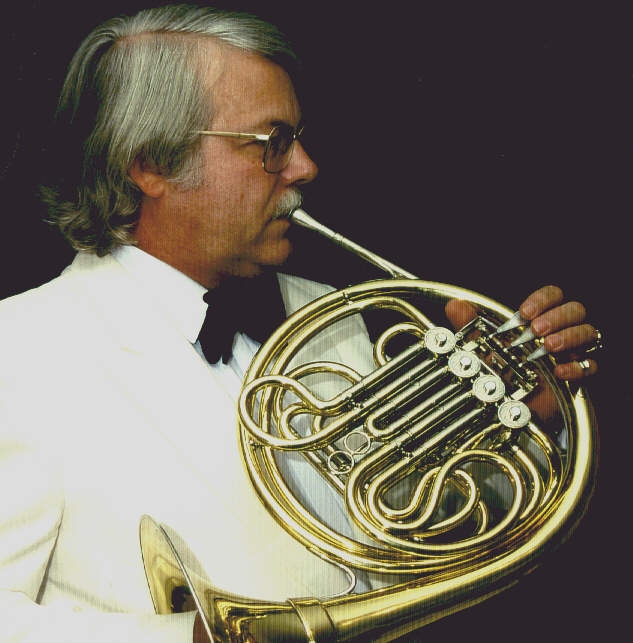
Double horn in F/Bb
|
(photo by Erich Pizka jun.- my younger brother, 1st Violinist in the Bav. State Orchestra). |
||
|
to the history of this instrument: Some time ago, I decided to join the illustre club of horn makers
by joining the forces of several young masters, to improve my very successful
horn, which I had designed by myself about twenty years ago. My horns were
made by my long friend. But my friend has retired from horn making or making
other brass instruments since 1992, but he continues with some research
in his one-room-studio to find out more about the "secrets" of our instruments,
the brass family, undergoing experiments to publish the results in a book
about Brass Instrument Making. So his
fame will remain alive with those who succeed him with the same passion,
profiting from his wisdom. He is open for any inquiry regarding his art
of brass instrument making, open for anybody. And I will be at your service,
passing all inquiries on to my friend. Anyway, all of you know, what make
of instruments I´m playing. I play two makes, but both are of my
own design.
This double horn as above is produced under my registered trademark Pizka - Classic ®. For the involved Hornmakers visit my extra page about the making of the horn. Find the link at the end of this page. This horn is real hand made and the
tubes are made of sheet metal of best yellow brass,
(I guarantee, that the brass sheet used for the leadpipe has never been cleaned by the use of any acidic solution ! The metal is not stretched or stressed when pressed upon the mandrel, as the leadpipe is not made from ready made tubes, but from specially sheet metal, cut to fit the required dimensions, bent in lead) The bell section is made of a one piece mushroom shaped flat brass sheet, bent together, soldered, softened & brought to the final form by traditional methods. The bending is done traditionally with the lead filled bell section. The total weight of the instrument: 2.750 grs (less than 92 ounces or five pounds), so not to be the lightest not the heaviest horn. Even the weight, resulting from the 0,5 mms strong sheet metal, which is down at 0,45 mms after the final polishing, has its advantage. It helps preventing the sound from breaking away in the higher dynamics and it makes the horn more resistant against wear. There is a new feature on this horn: the leadpipe is shortened at the front end so to force the player to hold the horn more upright resulting in a better angle between the leadpipe-mouthpiece-axis and the teeth. Wonder how the sound will improve by this trick. The yellow brass leadpipe will produce a very mellow sound, the sound of the nickel silver leadpipe is more penetrating in the higher dynamics but still extremely soft where necessary, the sterling silver gives the shiny velvet sound, which I prefer, but requires a bit more work for the first four weeks. The horn comes with some nice decorations, as the valve keys are with mother-in-pearl inlay & will not become slippery during the concert even in a very hot area. The valve cap nipples & the back screws have the same decoration. All at no extra charge. |
||
|
To change this horn from the F/Bb system to Bb/F system is no nightmare, but only a matter of losening two screws place them forward into two alternative holes & tighten. Very simple solution. |
||
|
Click at mpiece.htm the rim outside diameter of the mouthpiece is 24 mms
but the shoulder is very soft so not to hurt.
This mouthpiece comes in two technical versions only:
US taper shaft is regular if you order a mouthpiece, measure the leadpipe opening in millimeters, so the proper shaft can be provided but we will use three different metals:
The conversion of EUROs into US Dollars is very easy. Get the exchange rate EURO verse US Dollars (daily quotation) from the Internet, add the figure behind the dot as percentage (%) to the EURO price - and you will have the US $ price. example: if the EURO values 1.12 US $, you should add 12% to the EURO price to get the Dollar price. If the EURO is below the dollar value, deduct the missing numbers as % from the EURO price: e.g. if the EURO values 0,93 $ , deduct 7% from the EURO price to get the US dollar price. The mouthpiece consists of two parts & is screwed together & sealed. If you change your mind to use it for a horn with a wider mouthpiece receiver, no problem. Ask for the different shaft for another SB 15.- (brass) or SS 40.- (Sterling silver). Bring your old mouthpiece to your local repairman, get the head losened by use of heat of 175 degrees Celsius, unscrewed the mouthpiece head and screw on the new shaft, but do not forget the thiny drop of loctite ® to fix the head. If you have watched the process, you might try it by yourself the next time, you might change your mind & reverse the process again. the VAT has to be added for customers from within the European Union - prices will be marked in EURO beginning with January 1st 1999. |
||
|
|
||
|
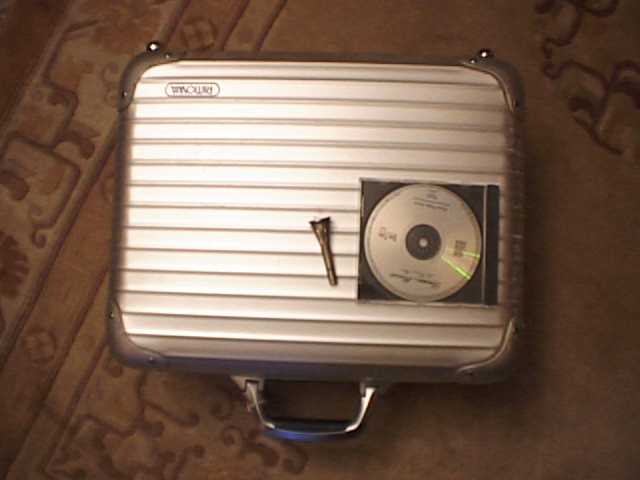
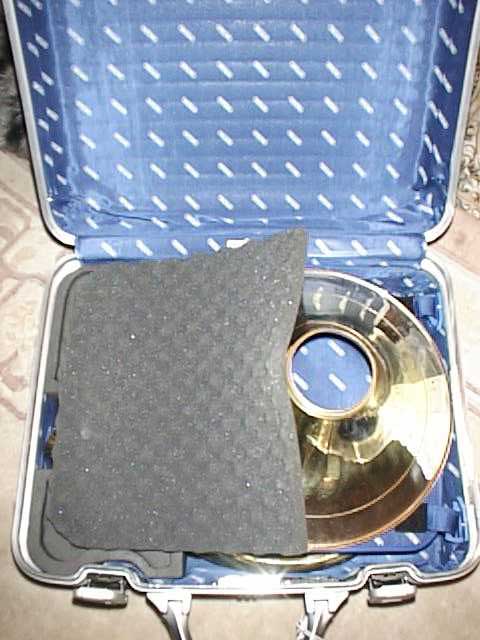
So the horn & the case will fit into the
5 kgs (ten pounds weight) regulations easily with a weigt of less than
4.800 grs. It is an IATA bord-case,
fitting all airline regulations for under the seat luggage. It is even
smaller than the regulations would allow. The
design will vary from time to time depending upon the availability of certain
models, but anyway be similar, of the same size & QUALITY.
click on the pictures to enlarge them
|
||
|
|
||
|
|
||
|
this horn is not for free, but the price will be civilized, EURO 4.250.- plus the VAT or customs, if required. In Germany there is a VAT (MWSt.) of 16% applicable to the net price. Please ask your bank for the actual exchange rate. At the moment it is less than US $ 4.000.- due to the exchange rate (May 2000: 1.- EURO = 0.92 US $) (this includes horn, lacquering, aluminum case, shipment inside Europe or seamail to other destinations ). There is a small surcharge for airfreight: EURO 50.- plus EURO 40.- for insurance. Shipment to the USA will be made via UPS & should arrive withing four / five days. The shipment will be fully covered by insurance. International parcel post would be cheaper, but US Mail does not accept unsealed (special seal) packages nor does it guarantee for replacements (not new for you, i think !). But we will use a new material for the valve rotors now. The price for these super rotors will be given soon. The horn price might be increased, perhaps, but not by hundreds of EUROs. The material comes from the space industry. It is a new metal alloy.It has excellent acoustical behavior and it is very resistant against any damage. The same material will be used for the Viennese Horn pistons. PRICES FOR HORNS & MOUTHPIECES ARE QUOTED IN THE NEW EUROPEAN CURRENCY, THE (EURO) NOW & ARE IN EFFECT FROM JANUARY 1st, 1999. ASK YOUR BANK FOR THE EXACT CONVERSION RATE. |
||
|
Every horn is a single piece of the Art of Brass Instrument Making. The valves (uniball only, no string action, sorry !) are absolutely noiseless & will work even after a four week summer lay off. The valves are so fast with their short action, that I had to adjust my playing to cope with this action. I have two of these instruments in use since 15 respectively 10 years, but under extensive hard duty. The valves of the elder horn had been taken out for inspection only once; there was nothing to clean. The other horn still has the valves on their place as they were when I received the horn 1988. This year they will be taken out, as the horn will be relacquered, even the lacquer is still nearly perfect after ten years. But I like it super perfect. If it ever happen to you, that a valve string broke just few minutes before a delicate solo or a difficult piece, and you had to struggle to bring the valve back to life, you would never ask for string action again. It happen to me just five minutes before Bruckner no.4 Symphony. So you might understand, why I swear upon ball joint action. |
||
|
just a short turn with flat-jawed pliers (if necessary) - and it works again perfectly even without oiling or watering before. Everything is traditionally hand made, well, using special tools off course. The single parts are produced in small series for a perfect matching. In the case, something will be broken on your horn, be sure, you will get the exactly matching spare part. They are perfectly calibrated. Late news of today:
Normally the bell is uncut. The price remains civilized with around EURO 3.600.- all included except VAT (16% tax for customers within the EU European Union ). The black case costs EURO 200.- net extra. They will come with a cut bell also to fit into the same light weight aluminium luxury case as the double horns, so to fit into the new airline on-board luggage regulations. The extra charge for a cut bell with the special trapezoid screw (damaging it will be hard) is EURO 250.-. The aluminium case costs EURO 250.- also. We also produce Wagner-Tuba upon special request & we follow the original Munich Wagner Tuba design. Robert Worischek also produces Huntinghorns of the Josef Schantl-Uhlmann design. They are sold for DM 2.300.- incl. VAT. A hard case is offered for DM 290.- incl. VAT. Even these horns are under Hans Pizka´s artistic control.
Ask for more informations, using email as below. |
||
| You
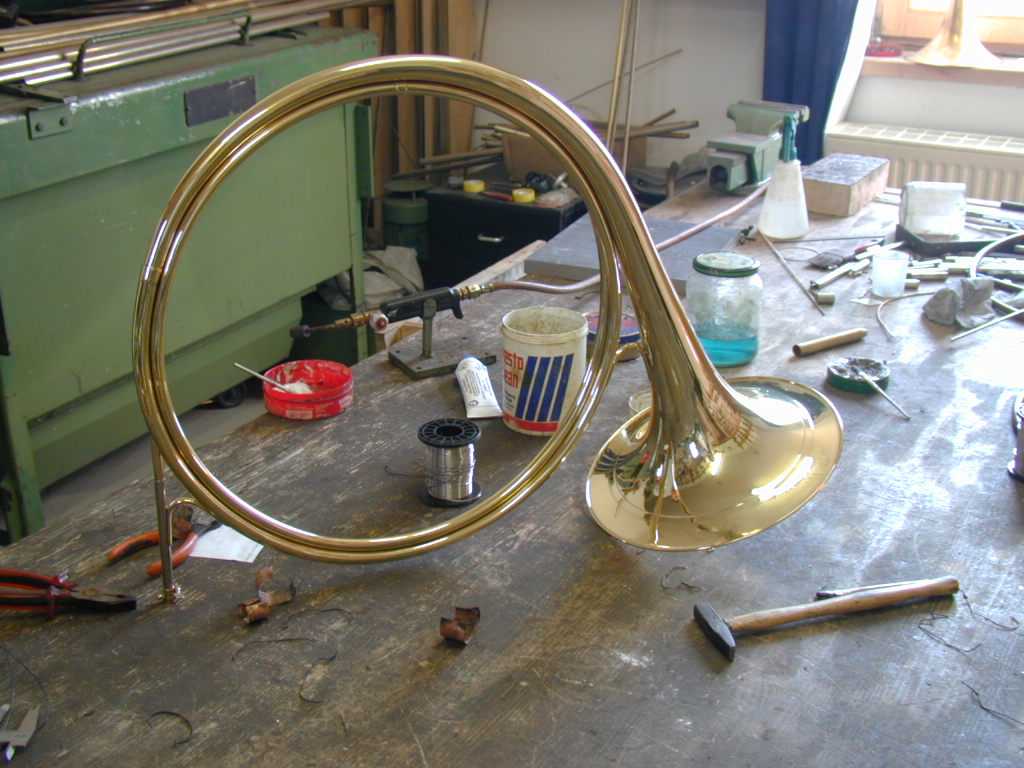
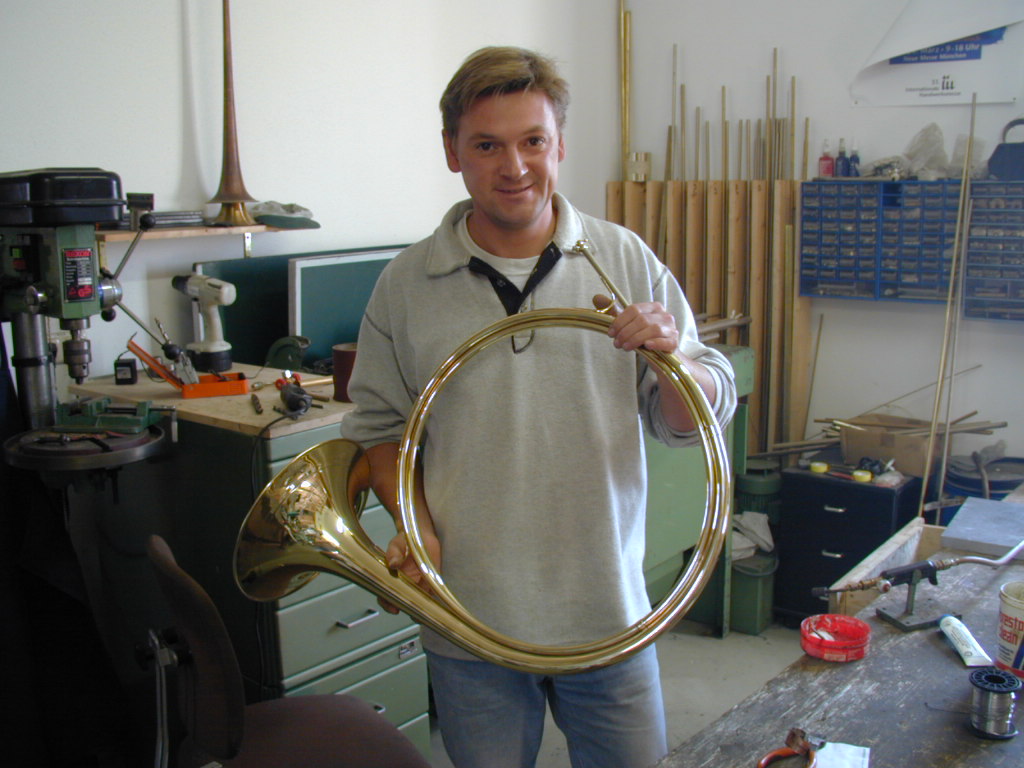
are interested to have a look onto the making of this horn ?
click here for pictures about making the horn: making.htm |
||
| My Japanese representative is: | Nero Wind Instrument Center | tel: (03) 3400 7466
email: nero@yo.rim.or.jp |
| click here for the Sitemap | click here for the main index | click here for the HPE (Hans Pizka Edition) subindex index.html |

Kontaktinformation Email: hans@pizka.de
last update: May 15th, 1998
© 1998 by Prof.Hans Pizka